

Corn curls, often known as cheese puffs or puffs, are a beloved snack worldwide. Their hallmark is a delightful combination of a light, airy texture and a flavorful, even coating. Achieving this perfect balance is a precise process that blends food science with careful craftsmanship. Here’s a breakdown of how to process high-quality corn curls.
1. Ingredient Selection: The Foundation of Quality
The journey to a superior corn curl begins with premium raw materials.
- Corn Meal/Grits: The primary ingredient is degerminated yellow corn meal. Its particle size is critical. Too fine, and the puff won’t form correctly; too coarse, and the texture will be gritty and dense. High-quality, consistently-sized corn grits ensure uniform expansion and a smooth melt-in-the-mouth feel.
- Oils: The choice of oil impacts flavor and mouthfeel. High-oleic sunflower or canola oil is often used for its neutral taste and stability during frying. For baking, oil is added to the mixture before extrusion.
- Seasonings: Quality seasonings are non-negotiable. This includes real cheese powder (e.g., cheddar, parmesan), whey, salt, buttermilk powder, and natural flavors. Anti-caking agents like silicon dioxide are added to the seasoning blend to prevent clumping and ensure a free-flowing powder that adheres evenly.
- Water: The quality and temperature of the water mixed with the cornmeal to form the dough are vital for the extrusion process.
2. The Extrusion Process: Creating the Curl
This is the most critical step where the signature puff is born. An extruder is a machine that cooks, shapes, and puffs the dough.
- Mixing and Pre-conditioning: Corn meal is blended with water and a small amount of oil to form a moist dough. This mixture is fed into the extruder.
- Cooking under Pressure and Heat: Inside the extruder barrel, the dough is subjected to high temperature and intense pressure. The moisture in the dough turns into superheated steam.
- The “Puff”: The cooked dough is forced through a die—a metal plate with specific-shaped holes. As the dough exits the die into the open air at atmospheric pressure, the sudden pressure drop causes the superheated water vapor to instantly expand, “puffing” the dough into its characteristic light, porous structure. The shape of the die determines the final shape of the curl.
Pro Tip for Quality: Precise control of moisture content, temperature, and pressure inside the extruder is essential. Even slight deviations can result in a snack that is too hard, too dense, or not fully cooked.
3. Drying (for Expanded Pellets)
After extrusion, the puffs have a high moisture content. They are conveyed through a multi-pass dryer. This gentle drying process reduces the moisture to a low level (typically 2-4%), creating a stable, shelf-stable base pellet. This step is crucial for achieving the ultimate crispness.
4. Application of Oil and Seasoning
To transform the bland, expanded pellets into the flavorful snack we know, oil and seasoning must be applied evenly.
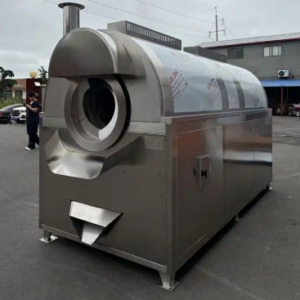
- The Coating Drum: The dried pellets are tumbled in a large, rotating drum.
- Oil Application: First, warm oil is sprayed as a fine mist onto the tumbling puffs. The oil acts as a glue, helping the seasoning powder adhere to the surface. The amount of oil must be precise—enough for flavor and adhesion, but not so much that the snack becomes greasy.
- Seasoning Application: The seasoning blend is then dusted or sprayed onto the oiled puffs. The constant tumbling action ensures every nook and cranny of the porous puff is coated uniformly.
Pro Tip for Quality: A homogenous coating is the mark of a premium product. Uneven coating leads to some puffs being bland and others overly salty or cheesy.
5. Cooling and Quality Control
The freshly coated corn curls are warm and slightly soft. They are conveyed to a cooling tunnel where ambient air cools them down, setting the coating and finalizing their crisp texture.
Before packaging, the curls pass over screening conveyors to remove any small broken pieces (“fines”) to ensure only whole, perfect curls are packaged. Optical sorters may also be used to detect and remove any discolored or misshapen products.
6. Packaging: Preserving Freshness and Crunch
The enemy of a high-quality corn curl is moisture and air. Packaging must be impeccable.
- Gas Flushing: Bags are flushed with an inert gas, like nitrogen, before sealing. This removes oxygen, which causes rancidity and staleness, and cushions the fragile puffs to prevent breakage during transit.
- High-Barrier Films: The packaging material is a multi-layer, high-barrier film that is impervious to moisture and oxygen, locking in freshness and crunch until the moment the bag is opened.
Key Takeaways for High Quality:
- Premium Ingredients: Never compromise on the quality of cornmeal, cheese powders, and oils.
- Precise Process Control: Meticulously manage moisture, temperature, and pressure during extrusion and drying.
- Even Coating: Ensure a consistent and uniform application of oil and seasoning.
- Protective Packaging: Use advanced packaging technology to protect the product’s texture and flavor from the elements.
By respecting these steps and focusing on consistency at every stage, producers can create corn curls that are irresistibly light, perfectly crispy, and bursting with flavor—the true hallmarks of a high-quality snack.




 English
  Russian
  Arabic
  Spanish
  Italian
  Portuguese
  French
  German