
The Manufacturing Process of Puffed Snacks
Puffed snacks, known for their light, airy texture and irresistible crunch, are a popular food category worldwide. From cheese balls to veggie straws, their appeal lies in the unique膨化 (puffing) process. This transformation of dense raw materials into a lightweight snack is a fascinating feat of food engineering. The process primarily involves applying heat and pressure to a starchy base before rapidly releasing it, causing the water inside to flash into steam and expand the product.
Here is a step-by-step breakdown of the typical manufacturing process for puffed snacks.
1. Ingredient Selection and Mixing
The primary ingredient is usually a starchy material like cornmeal, rice flour, wheat flour, or potato flakes. These base ingredients are combined with water, minor amounts of other grains, and pre-cooked in a large mixer to form a hydrated, dough-like mixture. This step gelatinizes the starch, making it ready for expansion. Salt, flavorings, and color may be added at this stage for integrated taste, though they are often applied later.
2. The Puffing Process: The Heart of Production
There are two main industrial methods for puffing: Extrusion and Puffing Guns (or Hot Air Puffing).
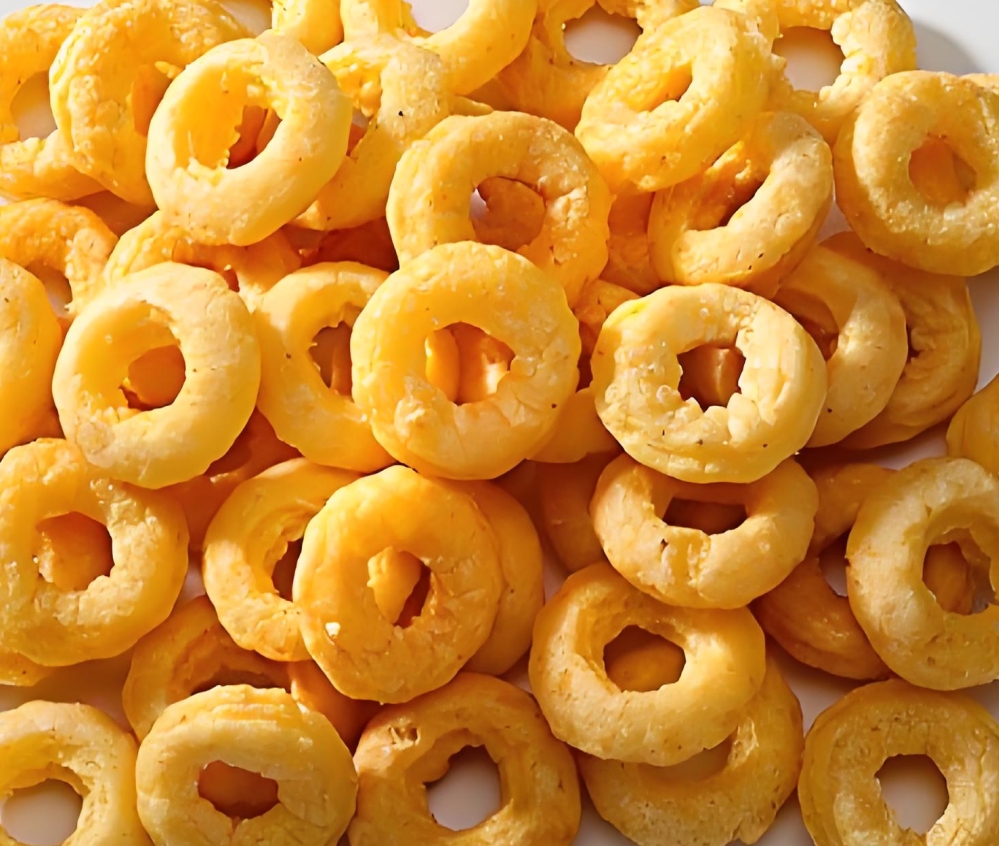
- Extrusion Puffing: This is the most common method. The prepared dough is fed into a machine called an extruder. Inside the extruder, a large screw conveys the dough through a barrel. The dough is subjected to intense heat, pressure, and mechanical shear. As it moves forward, the temperature and pressure rise significantly, cooking the mixture thoroughly. When this superheated paste is forced through a narrow die at the end of the barrel, there is a sudden, dramatic drop in pressure. The trapped water instantly vaporizes, flashing into steam and expanding the product, creating its characteristic porous, airy structure. The shape of the die determines the snack’s final form (e.g., circles, tubes, or rings).
- Puffing Gun (Hot Air Puffing): Often used for cereals or specific snacks like cheese puffs. In this method, the pre-mixed dough is first formed into small pellets or “half-products.” These dense, hard pellets are then fed into a rotating hot air gun. Inside the gun, they are exposed to very high temperatures, which builds up internal pressure. When the pressure is rapidly released, the pellets puff up dramatically, much like popcorn. This method can create a more random, irregular shape.
3. Drying and Cooling
After puffing, the snacks contain residual moisture. They are conveyed through a multi-pass dryer or a hot air oven to reduce the moisture content to a precise, low level. This ensures the signature crispness and extends shelf life by making the product less susceptible to microbial spoilage. After drying, the snacks are cooled to ambient temperature to stabilize their structure before seasoning.
4. Seasoning Application
This is a critical step for flavor development. The plain, puffed base moves into a rotating drum, often called a seasoning tumbler. As the snacks tumble, seasoning oils (e.g., vegetable or coconut oil) are sprayed onto them. This acts as a glue for dry powder seasonings like cheese powder, chili, sour cream & onion, or barbecue spice, which are then evenly dusted over the snacks. The tumbling action ensures a uniform coating.
5. Quality Control and Packaging
The final products pass through metal detectors and checkweighers to ensure safety and consistency. Optical sorters may also remove any misshapen or burnt pieces. Packaging is crucial for maintaining freshness and crunch. The snacks are immediately packaged in multi-layer laminated bags that provide an excellent barrier against moisture, oxygen, and light. Many bags are flushed with nitrogen gas before sealing. This inert gas displaces oxygen, which prevents oxidation (rancidity) and protects the product from being crushed during handling.
An Introduction to Powder Mixing Machines
Powder mixing machines, also known as powder blenders or mixers, are essential industrial equipment designed to combine dry powders and other solid ingredients into a homogeneous mixture. They play a critical role in industries such as food processing, pharmaceuticals, chemicals, and cosmetics, where consistency and uniformity in product quality are paramount.
Key Features and Design
These machines are engineered for efficiency, precision, and hygiene. Common designs include:
- Ribbon Mixers: Utilizing helical ribbons (inner and outer) to create opposing flows for thorough blending.
- Paddle Mixers: Employing paddles to gently mix fragile or cohesive powders.
- Plow Mixers: Using plow-shaped tools to generate intense mixing with optional choppers for breaking lumps.
- V-Conical Mixers: Tumbling materials in a V-shaped vessel for gentle, efficient mixing.
Constructed from stainless steel or other corrosion-resistant materials, they meet sanitary standards and are easy to clean. Many models feature jacketed vessels for heating or cooling during mixing.
How It Works
The mixing process involves loading ingredients into the machine’s chamber. Rotating blades, paddles, or the entire vessel (in tumble mixers) agitate the powders, ensuring even distribution. Operators control parameters like speed, time, and temperature to achieve desired consistency without damaging particles.
Applications
- Food Industry: Blending flour, spices, seasonings, and instant beverage powders.
- Pharmaceuticals: Mixing active ingredients and excipients for tablets and capsules.
- Chemicals: Preparing fertilizers, pigments, and detergents.
- Cosmetics: Combining powders for makeup, skincare, and other products.
Advantages
- Uniformity: Ensures consistent product quality batch after batch.
- Efficiency: Reduces mixing time compared to manual methods.
- Scalability: Available in lab-scale to large industrial sizes.
- Flexibility: Handles a wide range of powder densities and textures.
- Hygiene: Designed for easy cleaning and compliance with industry standards.





 English
  Russian
  Arabic
  Spanish
  Italian
  Portuguese
  French
  German