

How Are Different Shapes of Expanded Snacks Produced?
The world of expanded (puffed) snacks is a fascinating playground of shapes, from classic cheese puffs and balls to intricate rings, twists, and even animal figures. Achieving these diverse forms is not a matter of manual sculpting but a brilliant combination of food science, engineering, and culinary art. The primary technology behind this is extrusion cooking.
This article explains the industrial process of producing various shapes of puffed snacks.
The Heart of the Process: The Extruder
The key piece of equipment is an extruder. It is a long, heated barrel with a precision screw inside that mixes, cooks, and shapes the ingredients under high pressure and temperature.
The basic ingredients for most expanded snacks are:
- Base: Cornmeal, rice flour, wheat flour, potato flakes, or oat flour.
- Water: To create steam and form a dough.
- Flavorings: Added as powder, liquid, or cheese slurry.
- Oil: Often added for taste and mouthfeel.
The Two Main Types of Expansion
Understanding how expansion works is crucial to understanding shape formation:
- Direct Expansion (Puffing at the Die):
- This is the most common method for lightweight, airy snacks like cheese puffs.
- The ingredient mixture is fed into the extruder. As the screw pushes it through the heated barrel, the intense pressure and temperature cook the dough, superheating the water within into steam.
- When this hot, pressurized dough is forced through a specially designed die (a shaped hole) at the end of the barrel, it instantly encounters atmospheric pressure.
- This sudden pressure drop causes the superheated water flash into steam, expanding the starchy matrix rapidly and creating a puffed, airy structure. The shape is set instantly as the product expands through the die.
- Indirect Expansion (Frying or Baking):
- This method is used for denser, harder snacks like certain chips or pretzels.
- The extruder is used primarily for mixing and shaping, not for full expansion. The dough is cooked at a lower temperature and pushed through a die to form a specific, dense shape (e.g., a pellet or a flat shape).
- These dense, pre-formed pieces are then dried to a stable shelf life. This semi-finished product is called a half-product or pellet.
- In a second, separate step, the consumer goods manufacturer or the end consumer fries these pellets in hot oil or bakes them in a hot oven. The remaining moisture turns to steam, causing the pellet to puff up into its final, rigid shape.
How Are Specific Shapes Created?
The shape is determined almost entirely by the die plate and the cutting mechanism at the end of the extruder.
1. Simple Shapes (Balls, Puffs, Curls):
- Die: A simple round hole.
- Process: The molten dough is forced through the round die. As it exits and puffs, a rotating knife cuts it at precise intervals.
- Creating Curls: If the knife cuts the emerging rope of puffed product at an angle or if the product is laid on a conveyor belt in a way that it curls as it cools, you get the classic cheese curl shape.
2. Complex Shapes (Rings, Stars, Animals):
- Die: Intricately designed dies with the shape cut out of them (e.g., a star, a dinosaur).
- Process: The dough is forced through this complex die. The expansion happens immediately after, faithfully replicating the die’s shape in 3D. The cutting knife slices the continuous flow of puffed shapes into individual pieces. The skill lies in formulating the dough’s viscosity and moisture content so it expands perfectly to fill the die’s shape without collapsing.
3. Filled Snacks:
- Dies: A specialized co-extrusion die is used. It consists of two concentric holes.
- Process: One stream of dough (e.g., for the outer shell) is pushed through the outer ring. Simultaneously, a filling (e.g., cheese, chocolate, peanut butter) is pumped through the inner ring. The two are combined and co-extruded together, creating a filled snack that is then cut and baked or fried.
Post-Extrusion Processing
After the product is shaped and expanded, it undergoes several more steps:
- Drying/Cooling: The puffed product has a high moisture content and is soft. It is conveyed through a dryer or cooler to become crisp and stable.
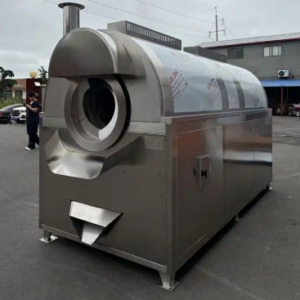
- Seasoning Application: The bare, puffed snacks enter a rotating drum, often called a tumbler. Here, seasonings—whether powdered cheese, salt, barbecue dust, or a light coating of oil—are evenly applied. The oil helps the dry powder adhere to the snack’s surface.
- Packaging: The finished snacks are immediately packaged in moisture-proof and air-tight bags, often with a nitrogen flush to prevent staleness and breakage.
Summary of the Shape Creation Process
| Desired Shape | Primary Method | Key Tool |
|---|---|---|
| Balls, Puffs | Direct Expansion | Round Die + Straight Cut |
| Curls | Direct Expansion | Round Die + Angled Cut or Curling Belt |
| Rings, Stars, Animals | Direct Expansion | Intricately Shaped Die |
| Dense Chips, Pretzels | Indirect Expansion | Shaped Die (for pellets) + Frying/Baking |
| Filled Snacks | Co-Extrusion | Multi-Channel Die |
Conclusion
Creating the vast array of puffed snack shapes is a highly automated and precise engineering feat. It all revolves around the extruder and the design of the die through which the superheated dough is forced. By manipulating the recipe, die shape, cutting speed, and post-extrusion processing, manufacturers can produce an endless variety of fun, appealing, and delicious expanded snacks that fill supermarket shelves worldwide.




 English
  Russian
  Arabic
  Spanish
  Italian
  Portuguese
  French
  German